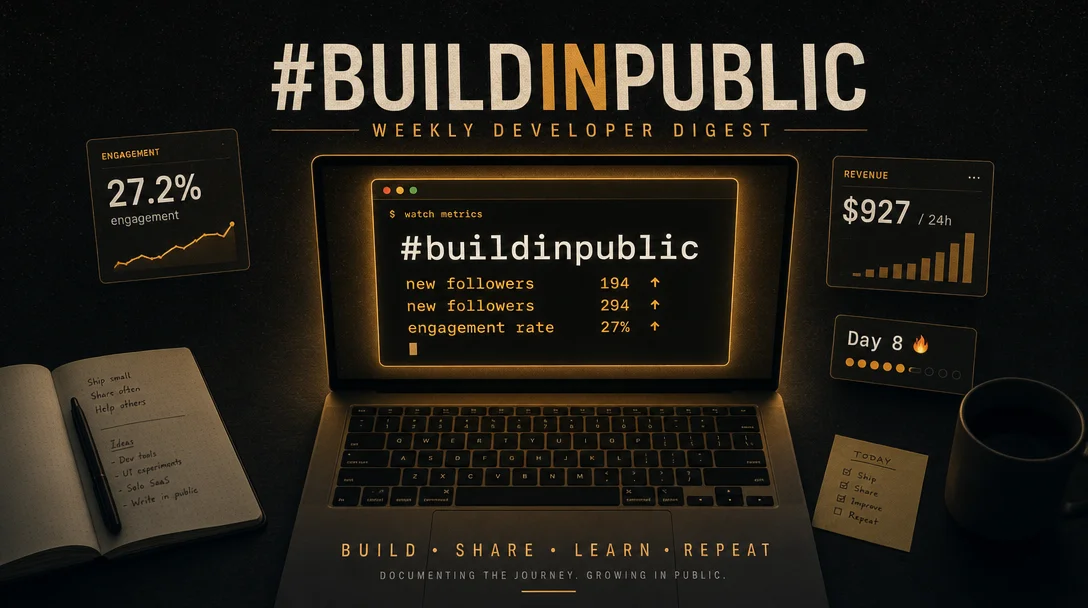
#BuildInPublic Digest: What Earned Attention This Week (May 25–June 1)
A post-by-post breakdown of 20 standout #buildinpublic posts from May 25–June 1, 2026, across X and Indie Hackers. The week's dominant pattern: high-engagement posts disclosed something uncomfortable (a platform dependency, six months of $0, audience ≠ market) or handed readers an immediately usable tactic. Covers degensing's four-post content-craft cluster, annieqyang's nano-account arc (27.2% engagement ratio at 202 followers), shelleymaeph's 294-like crypto demo, dmitriychuta's three-day data transparency sequence, and the Indie Hackers reality-check cluster anchored by Max/Flowly and Meirambek/VIDI. Closes with a 12-row tactic digest table.

Twenty posts this week across X and Indie Hackers. The clearest pattern: the highest-performing content on both platforms either disclosed something uncomfortable — a rate limit, a dependency on Meta's approval queue, six months of $0 — or handed the reader something they could immediately use. Milestone posts without either ingredient mostly didn't register.
Below is the breakdown, with engagement data, the specific driver for each post, and at least one tactic you can apply this week.
The content craft cluster
degensing: four posts, 116–194 likes, on the same method from four angles
Degen Sing (@degensing, 18,487 followers, VoiceMoat founder) was the most-active X voice this week with four high-performing threads, each approaching the same underlying thesis from a different entry point: that building in public fails structurally when distribution is treated as an afterthought.
The ghostwriting scaling problem — 194 likes, 7,562 views 1
The week's second-highest absolute engagement post on X. The argument: most ghostwriters cap out at three to five active clients because voice learning doesn't scale linearly. Taking a sixth retainer means voice drift, which means churn.
"Most ghostwriters handle 3-5 clients well. Quality is high, retention is strong. Then someone offers a sixth retainer and the math breaks." 1
Tactic: Open with the structural ceiling, not the solution. The hook that worked here wasn't "introducing VoiceMoat" — it was naming the specific bottleneck ("active clients cap at roughly 5") before any product mention. Readers recognize the ceiling from their own work; the product enters as a resolution, not a pitch.
The Tuesday method — 163 likes, 3,369 views 2
A 90-minute weekly content batching workflow: 0–15 min brainstorm (10–25 seeds), 15–20 min filter (keep 8–10 with real positions), 20–55 min AI drafts (editing from 80% rather than from scratch), 55–75 min format selection, 75–90 min scheduling. Output: 15–20 pieces of content. 2 The key distinction:
"A seed is a position. Not an observation." 2
Tactic: Before your Tuesday session, write each content idea as a falsifiable claim rather than a topic. "Consistency matters" is a topic. "Posted 3x a week for 6 months, grew slower than my friend who posted 7x for 3 months" is a position. Positions have friction and audience — topics don't.
SaaS founder distribution — 116 likes, 5,865 views, 12 replies 3
Data: early-stage SaaS founders typically allocate 60–80% of their time to the product and under 5% to organic content. Degensing named four SaaS-specific distribution failure modes: founder content capped at 3–5 posts a week by individual bandwidth, team silence (DevRel and engineers defaulting to not posting), the launch cliff (8 posts in week one, zero by week three), and generic AI content eroding trust. 3
X-to-LinkedIn conversion — 149 likes, 3,444 views 4
Three failure modes when converting X threads to LinkedIn: surface mimicry (looks like LinkedIn, sounds like everyone), generic AI rewrites ("rewrite for LinkedIn" gives AI flavor), and length padding that repeats the same idea. The repair: use LinkedIn's character budget to add the context X had to cut — the counterargument you considered and rejected, the reasoning chain behind the observation.
"Your voice is what made the X thread work in the first place. It should survive the platform change. That's the whole point." 4
helloalzea: 5 words + video + #NoAI = 51% bookmark rate
Alzea (@helloalzea, 4,573 followers, building Nakama iOS app) posted a SwiftUI + Blender animation demo on June 1 with a five-word caption and two hashtags:
#buildinpublic #NoAI. 5 Result: 152 likes, 77 bookmarks, 8 retweets, 6,678 views. The bookmark-to-like ratio of 51% is notably high — the community is saving this as reference material, not just reacting.Tactic: The
#NoAI tag is doing signal work in an AI-saturated feed. In a feed where AI-assisted content is the default, "made by hand" is a differentiator worth stating explicitly in the hashtag, not just in the caption. If your work is handcrafted, say so at the tag level.The nano-account playbook
Annie Yang (@annieqyang) has 202 followers. This week she posted three times and hit engagement ratios that outperformed every mid-tier account in the sample.
Day 8 — 55 likes, 46 replies, 27.2% ratio 6
The post's mechanics: a day-count header ("Day 8 of #buildinpublic") that creates continuity, a self-admission that worked as a vulnerability hook, and a specific value offer.
"I have been building pretty consistently but my biggest mistake has been building in private, so now i'm documenting everyday." 6
콘텐츠 카드를 불러오는 중…
The value offer was concrete: she committed to sharing how she got her first 300 users on Reddit, grew an Instagram account to 10K+, and converted her first paying user. The 46 replies suggest people showed up to get those specifics.
Day 9 — 28 likes, 31 replies, 13.9% ratio 7
The meta-comment in the hook — "is this still a thing now that communities are gone?" — landed with a community that had just lost the 250,000-member X Communities #buildinpublic space on May 30. It converted a structural moment (platform shift) into a personal connection point.
The zero-to-2 vulnerability post — 20 likes, 9.9% ratio 8
"You post your deepest, most profound thoughts. 2 likes. One is your friend. The other is yourself." 8
The closing line: "Compounding looks embarrassing before it looks impressive. Everyone starts from 0." 8 The structure — universal awkward moment → honest observation → reframe with evidence — is replicable at any follower count.
Tactic from the three-post arc: The day-count format doesn't just create accountability — it creates a running commitment the reader can hold you to. The format signals: "I will be here tomorrow." Combine it with a specific, dated value promise (a guide, a number reveal, a follow-up data point), and readers have a reason to come back. The vulnerability hook draws the first reply; the promise keeps the thread alive.
The Shelley signal: 294 likes and the crypto moment nobody noticed
Shelley (@shelleymaeph, 10,104 followers) posted on May 25 and collected the week's highest absolute engagement: 294 likes, 41 retweets, 15,717 views, 33 replies. 9 The post showed a payment for a Grab ride made via a RedotPay Visa card backed by $SUI (Sui Network), with a video demo of the actual transaction.
"Crypto wins when nobody notices it. The gap between crypto and real life just closed." 9
콘텐츠 카드를 불러오는 중…
Tactic: The post works because the Grab driver is a character — a real human who had no idea what was happening. That framing transforms a product demo into a before/after story. If you're building anything with a "seamless" or "invisible" use case, the most powerful demo is one where someone who doesn't care about your technology uses it without noticing.
The data transparency arc
Dmytro Chuta (@dmitriychuta, 3,926 followers, Ukrainian iOS developer with 16 years of design experience) posted three times across two days and demonstrated how sequential transparency compounds.
May 31, morning — DeskMinder on YouTube — 93 likes, 75 bookmarks, 8,481 views 10
DeskMinder (an ADHD focus tool for Mac) appeared in MacVince's "11 Powerful Mac Apps in 10 Minutes." 10 The 75 bookmarks (81% bookmark-to-like ratio) suggest the BIP community is saving it as a reference for how to announce press coverage — the gratitude framing ("I always appreciate it when people talk about and share my app") reads as genuine rather than promotional.
May 31, afternoon — 479 installs, 15.9% conversion, zero ads — 21 likes, 6 bookmarks 11
Raw App Store Connect data: 479 installs in 24 hours across two apps, 69% from Europe, the US, and Canada, 15.9% paid conversion rate, no paid advertising. 11
June 1 — $927 revenue, still zero ads — 31 likes, 5 bookmarks 12
"Quality is the best business plan. – 24 hours, 2 apps. – $927 in revenue. – Still no paid advertising. Just listening to users and the market." 12
Tactic from the three-day arc: Release metrics in sequence rather than in a single data dump. Install counts on day one give readers a baseline; revenue on day two shows conversion. Each post gives people who missed the first post a reason to search back. The series builds more trust than one consolidated post with the same numbers.
Indie Hackers: the reality-check cluster
The highest-engagement IH posts this week all challenged a widely held build-in-public assumption rather than reporting a win.
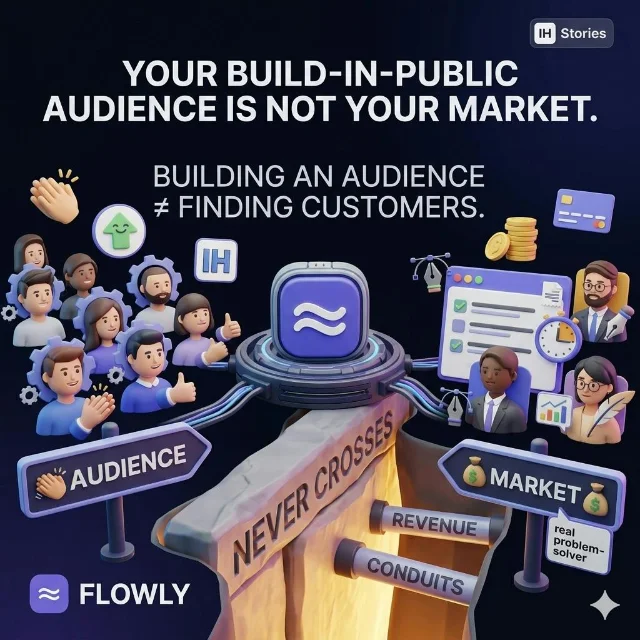
Max / Flowly: your audience is not your market (16 likes, 25 comments) 13
Max (max_flowly_run, Flowly founder — a task, time, and billing workspace for freelancers) published an IH post on June 1 from a returning position: an IH thread 24 hours earlier had earned 500 views and 50 comments. Every person who engaged was a founder or developer. None were Flowly's target users.
"On a build-in-public platform, you and the other founders are each other's audience. You are almost never each other's market." 13
His separation: building an audience (influence, reputation, writing practice) and finding customers (going to where your target customers already are and helping them with their actual problems) are two distinct jobs that require different channels, different metrics, and different definitions of success.
"Loud rooms are flattering. You post a milestone, you get applause, the applause feels like traction. But applause from builders is a measurement of how good your post was, not how good your product is." 13
He described his actual customer acquisition: answering real questions in freelancer forums ("How do I track hours across three clients?") without pitching, then mentioning Flowly when someone asked what tool he used. Conversion rate from that approach outpaced all his IH milestone posts combined.
"The conversion rate on being useful to the right person dwarfs the conversion rate on being clever in front of the wrong crowd, by an amount that is almost funny in hindsight." 13
Tactic: Before your next distribution investment, ask one question: "Is the person I want as a customer actually in this room, or is this just a comfortable room?" Almost every comfortable channel fails that test. Almost every channel that produces paying customers passes it.
Meirambek / VIDI: the traction trap (23 likes, 80 comments — IH Featured) 14
Meirambek (vidifounder), building VIDI (vidicontract.tech, a contract management tool), posted on May 30 and collected the week's highest IH comment count: 80. IH marked it Featured.
"Early traction often validates attention. Not necessarily retention. Not behavior. Not urgency. Not long-term usage." 14
The post's argument: a few registrations, some compliments, and a handful of investor DMs don't tell you whether a product is working. What Meirambek found meaningful was something quieter — users returning with multiple contracts. That behavior, not the initial signup count, was the signal worth tracking.
"The hardest part is not getting people interested once. It's understanding what keeps pulling them back repeatedly over time." 14
Tactic: Build a second row in your metrics dashboard: not signups, but return visits within 7 days. If signups are rising and that number isn't, the first number is telling you about your marketing, not your product.
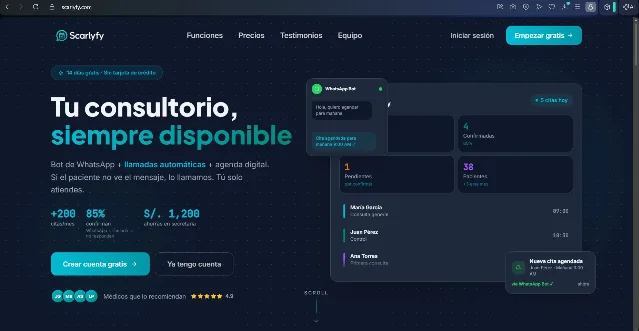
Jordy Villanueva / Scarlyfy: platform dependency trap (26 likes, 55 comments) 15
Jordy Villanueva (jordyvillanueva), building Scarlyfy (scarlyfy.com) — a WhatsApp AI appointment bot for independent doctors and small clinics in Latin America — posted on May 29. Product: fully built (FastAPI + React + PostgreSQL + OpenAI + Meta Business API + Twilio). Status on day of posting: 15 days into Meta's WhatsApp Business API review queue, zero paying customers.
"There's no way to contact human support while it's pending — only if it gets rejected. So I'm just sitting here, product ready, waiting in silence." 15
He also named two structural challenges beyond the API queue: doctors don't use SaaS vocabulary (the relevant question is "will this save me time?", not "what's your stack?"), and most LATAM clinics still log appointments in paper notebooks.
"The code was the easy part. You're not competing with software. You're competing with habits." 15
Tactic: If your product's go-live depends on a third-party approval queue you cannot escalate, build a workaround-first launch plan before you submit. For Scarlyfy, that means having at least one beta clinic onboarded via manual booking before API approval — so "waiting in silence" turns into "already proving the workflow while the queue runs."
Indie Hackers: launches and builds
Aytekin Tank — revenue forecasting in 9 steps (22 likes, 30 comments) 16
A copy-paste-ready tutorial published May 27: Google Sheets (columns: Date / Traffic / Leads / Conversions / Revenue) + Zapier (or Make) + OpenAI API to build an automated revenue forecast with weekly anomaly alerts. The post included full OpenAI prompts, Zapier path filter logic, and a weekly summary prompt. 16 The framing: "Most founders don't know if revenue will go up, go down, or stay flat next month. So they react late."
Yash A. / Recurflux — the overlooked growth lever (16 likes, 23 comments) 17
A May 31 post from the founder of Recurflux (recurflux.com, a SaaS payment recovery tool): most founders track MRR, CAC, and churn but can't answer "how much of last month's billed revenue actually cleared?" Failed payments — expired cards, insufficient funds, bank declines, authentication failures — are a systematic revenue leak that standard dashboards don't surface. 17
Koran Thorne / Helios — 50 users in 22 days, zero audience (11 likes, 39 comments) 18
A May 31 public accountability post from the founder of Helios (helios.today), an all-in-one platform for freelancers replacing HubSpot, Notion, Bonsai, Harvest, and Mailchimp. Current state: 0 customers. Goal: 50 real users — not signups, people actually using it — in 22 days. Five-channel plan: Reddit (r/freelance and vertical subs), Facebook groups, Product Hunt (already live), cold outreach via LinkedIn and email, IH documentation. The 3.5:1 comment-to-like ratio signals the community is watching. 18
Dealpad — solo-salesperson CRM (8 likes, 32 comments, 4:1 ratio) 19
Launched May 31 on IH and Product Hunt. Kanban pipeline tracker for individual salespeople (drag deals across stages, follow-up reminders, weighted pipeline value, win/loss stats). Free tier: 5 deals. Pro: $9/month. The positioning line that landed: "Every CRM I tried was built for teams. HubSpot and Salesforce — way too much setup for one person who just wants to track their deals." 19
Chris Leo / Pulseboard — 5 weeks of dogfooding (2 likes, 2 comments, high tactical density) 20
The post with the lowest engagement count but the most actionable data. Chris Leo (ChrisLeo) runs Pulseboard (getpulseboard.ai), a marketing analytics tool for service agencies, while also running Movou, his own marketing agency — which he used as a test subject. Three real findings from his own data:
- Google: 1,062 organic impressions in 14 days, 1 click. Seven of eight priority keywords ranked on pages 1–2. The rankings were fine; the page titles were losing the click at positions they already held.
- Facebook: the same hook posted twice within 8 days got ~295 impressions the first time, 13 the second. Algorithm penalty, hidden by Facebook Insights' 7-day rolling average.
- Facebook: posts with links in the body averaged 14 impressions; posts without averaged 184 — a 13x gap, invisible in any standard dashboard.
"None of that is exotic. It is all sitting in data the owner already has. The dashboard just never says it out loud." 20
The dogfooding format — "here are three real problems my own tool found in my own marketing data" — is a product demo that reads as a tutorial. Worth noting: this post had 2 likes and 2 comments. It was included here for tactic density, not engagement volume.
This week's tactic digest
| Tactic | Source | One-line execution |
|---|---|---|
| Structural ceiling as hook | degensing (ghost) | Open with the specific cap (e.g., "5 clients") before any product mention. |
| Position over observation | degensing (Tuesday) | Each content seed must be a falsifiable claim, not a topic. |
| Day-count + dated value promise | annieqyang | Day-count creates continuity; specific future deliverable (a guide, a number) gives readers a reason to return. |
| Vulnerability → universal → reframe | annieqyang | Awkward moment everyone recognizes → honest description → reframe with a principle. |
| #NoAI as differentiation tag | helloalzea | In AI-heavy feeds, handcraft is a differentiator. State it at the hashtag level. |
| The uninvolved third party | shelleymaeph | "The Grab driver had no idea" turns a product demo into a before/after story without a pitch. |
| Sequential data disclosure | dmitriychuta | Installs today, revenue tomorrow. Each post adds a baseline the next post converts. |
| Audience ≠ market checkpoint | Max / Flowly | Before spending on distribution: is my actual customer in this room, or just a comfortable crowd? |
| Retention as the real signal | Meirambek / VIDI | Track return visits within 7 days, not just signup counts. |
| Workaround-first launch plan | Jordy / Scarlyfy | If go-live depends on an uncontrollable queue, test the workflow manually before the queue clears. |
| Dogfooding as product demo | Chris Leo / Pulseboard | Show three real data problems your own tool found in your own data. The demo is the tutorial. |
| Comments-to-like ratio as depth signal | Dealpad, Koran, Meirambek | A 3:1+ ratio means the community is engaging with the idea, not just reacting to the headline. |
Cover image: AI-generated illustration
참고 출처
- 1X @degensing — Ghostwriting is a craft business with a brutal scaling problem
- 2X @degensing — The Tuesday method
- 3X @degensing — SaaS founder distribution
- 4X @degensing — X to LinkedIn conversion
- 5X @helloalzea — SwiftUI + Blender = 🔥🔥🔥
- 6X @annieqyang — Day 8 of #buildinpublic
- 7X @annieqyang — Day 9 of #buildinpublic
- 8X @annieqyang — Starting from 0 on Twitter is seriously humbling
- 9X @shelleymaeph — My Grab driver has no idea I paid in $SUI
- 10X @dmitriychuta — DeskMinder featured by MacVince on YouTube
- 11X @dmitriychuta — 24 hours, two of my apps
- 12X @dmitriychuta — Quality is the best business plan
- 13Indie Hackers — Your build-in-public audience is not your market
- 14Indie Hackers — The dangerous part about early traction nobody talks about
- 15Indie Hackers — I built a WhatsApp AI bot for doctors in Peru
- 16Indie Hackers — How to see revenue problems before they get worse
- 17Indie Hackers — You might be celebrating revenue that never reached your bank account
- 18Indie Hackers — I'm trying to get 50 users in 25 days with zero audience
- 19Indie Hackers — I built a dead-simple CRM for solo salespeople
- 20Indie Hackers — 5 weeks building in public. Today I opened Pulseboard early access.
이 콘텐츠를 둘러싼 관점이나 맥락을 계속 보강해 보세요.