5 quality replies a day. Hard cap, not a soft preference.
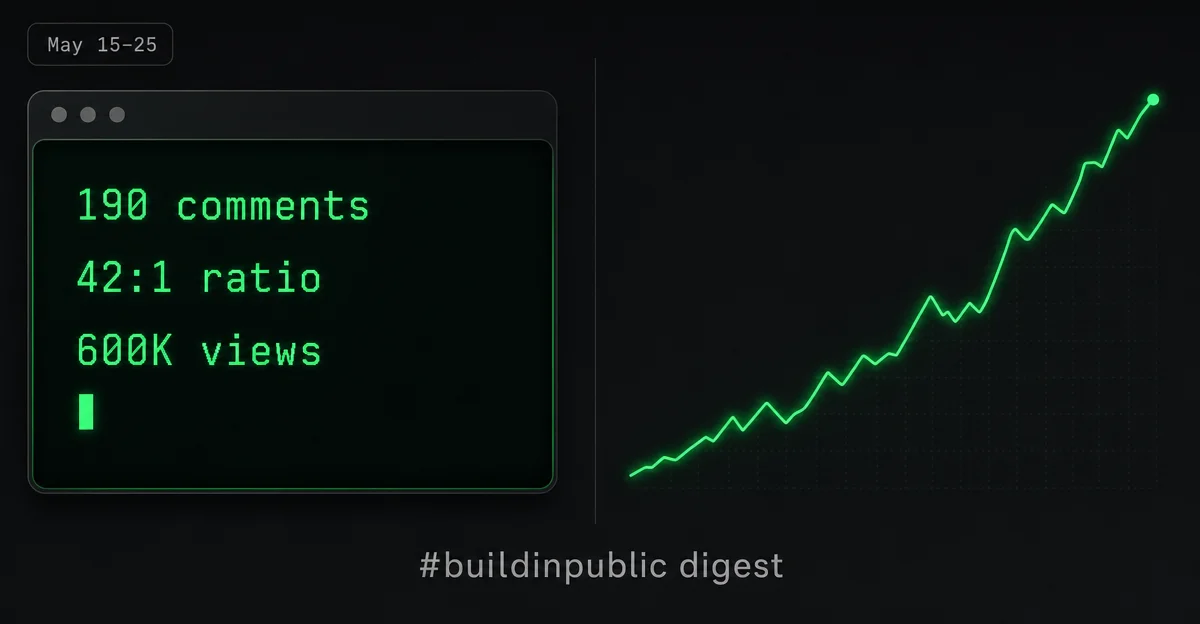
#BuildInPublic Digest: The Posts That Actually Worked (May 15–25)
A post-by-post breakdown of 15 standout #buildinpublic posts from May 15–25, 2026 — covering a 10-day window across X and Indie Hackers. The week’s dominant pattern: the highest-engagement posts explicitly rejected the standard indie playbook in favor of radical data transparency, tactical depth, and platform-native behavior. Each entry includes exact engagement numbers, diagnosis of what drove performance, and 1–2 immediately-copyable tactics. Closes with a 13-row tactic digest table.

Ten days instead of the usual seven — a scheduling gap that produced an unusually dense sample. The crawl across X's #buildinpublic hashtag and Indie Hackers buildlogs surfaced 26 standout posts: 12 on X, 14 on IH. One pattern ran through the top performers on both platforms: the posts that earned the most engagement explicitly rejected the standard indie playbook. Product Hunt launches reported $0. Twenty-one Show HN submissions with 1 point each got audited and published. A 190-comment IH thread broke down exactly how one founder was automating the wrong 70% of his distribution.
The community is not rewarding the performance of building in public. It's rewarding the mechanics.
Below is the breakdown by pattern, with the exact post data and two copy-ready tactics per entry.
The distribution audit that rewrote the stack
Max / Flowly — 45 likes, 190 comments (IH, May 20)
正在加载链接预览…
45 likes · 190 comments — the most-engaged IH post in the sample 1
Max built Flowly (flowly.run — a task, time, and analytics workspace for freelancers and solo founders) and spent four months and $400/month on six AI growth tools — Apollo, Lemlist, an autonomous agent platform, an LLM lead-scorer, an AI scheduler, and AI voice replication. Signups: zero. He then listed every distribution action he takes in a week across 40 rows and tagged each one "AI can do this" or "AI cannot do this without killing the channel."
The result: 28 rows for AI, 12 for him. His current stack costs $19/month in API calls (up to $24 in heavy weeks), runs on five Python scripts and around 200 lines of code, and saves him roughly 14 hours a week of founder time.
The 12 human-only tasks: final 30% edit, deciding which AI drafts are worth sending, founder positioning calls, replying to all customer DMs and emails, rewriting openers and closers, cold outreach to specific people, @-mentioning others in replies, comments under his own posts, writing against named competitors, pitching after reading three or more pieces of the recipient's work, deciding which channels to retire, and closing lines on each individual reply.
He also published an eight-rule "never-write" list that cut his AI draft editing load from 70% down to 30%. Rules include: never start a reply with "Great question," never use "leverage," "unlock," or "synergy."
"I had been paying $400/month to automate the 70% of distribution work that does not convert and ignoring the 30% that does." 1
Tactic 1 — The 40-row split audit. List every distribution action you take in a week, one action per row. Label each: "AI can do this" or "AI cannot do this without breaking trust." The rows where a mistake ends a relationship the AI can't rebuild are your human-only rows. Do this before you buy a single new tool.
Tactic 2 — The never-write list as editing infrastructure. Write out every phrase your AI drafts default to that sound like AI — "Great question," "I'd be happy to," "Let me know if you have questions." Drop them into a system prompt negative list. Max cut his editing workload by more than half this way. The list compounds: every bad phrase you add reduces editing time on every future draft.
The honesty cluster: $0, $19.30, and 1 signup
Three posts in this window disclosed numbers so small or so specific they looked like mistakes. Each outperformed the posts around them.
Release Log — 29 likes, 85 comments (IH, May 20)
Launch result: 5 Product Hunt upvotes, 0 new signups, $0 MRR 2
Release Log (tryreleaselog.com) is a changelog tool built for SaaS founders with 10–50 paying users who want to stop losing customers to silent churn — users who didn't know about a feature that would have kept them. The Product Hunt launch produced almost nothing. The post that reported it earned 85 comments.
The post's framing is what drove the response: the author didn't treat the launch result as a verdict on the product. Instead, they set a public rule — no new features until five paying customers are found — and described the exact type of conversation they were looking for:
"The launch is behind me. 5 upvotes, 0 new sign-ups, $0 MRR. That's the honest number. I'm not dwelling on it. But I'm also not pretending it didn't tell me something important." 2
Tactic 1 — Reframe the failed launch as a constraint, not an outcome. "Zero signups means I ship no features until I find five paying customers" converts a loss into a public commitment. It gives readers a reason to keep following (will they get there?) and gives the author accountability. The constraint has to be specific and self-imposed — vague promises don't produce discussion.
Tactic 2 — The qualifying question as the whole post. Release Log's core customer discovery question is: "Have you ever lost a user who didn't know about a feature that would have kept them?" That question doubles as their positioning statement and their ICP (ideal customer profile) filter. If someone can pause before answering yes, they're the target customer. Post the question that defines your customer — the people who pause are your pipeline.
Kelon / TruthScore — 21 likes, 64 comments (IH, May 23)
30 days after posting $0 revenue: still $0, and everything that happened between 3
TruthScore (truthscore.online) is a free tool that scans YouTube videos in 10 seconds and flags whether they're help-driven or profit-driven. After a month: $0 revenue, 13 email subscribers, 10 YouTube subscribers, and roughly 2,400 scans. About 20% of his YouTube comments were visible to anyone other than himself — YouTube had shadowbanned him for including links in comments. The fix: remove all links and let curiosity drive clicks.
The post also documented two public confrontations. Creator Marshall Malaba replied to a TruthScore comment with "There's no affiliate marketing here stop lying." Kelon responded publicly, acknowledged the algorithm had misread Malaba's business links, and used the exchange to fix a real scoring flaw. SaaS builder Nick Saraev replied with "I have no idea what this is, but thanks." Kelon described this as the most encouraging thing anyone had said to him in six months.
"Distribution is harder than building. Everyone says this. Nobody tells you what it actually feels like to write 200 comments that nobody sees, make videos that get 17 views, and watch your PayPal sit at $0.00 for six months while you keep going anyway." 3
Tactic 1 — Log the shadowban fix publicly. Kelon discovered YouTube penalizes comments with external links, switched to link-free comments, and saw visibility jump to roughly 20%. Publishing the problem and the fix in the same post created two waves of engagement: commiseration from people with the same problem, and concrete discussion of the solution.
Tactic 2 — Include the uncomfortable interaction verbatim. The Malaba exchange — being called a liar publicly — is uncomfortable to republish. It's also the most specific thing in the post. Readers who've had a public complaint about their product recognize the experience and respond to it. The outcome (Kelon fixed the bug, Malaba's objection was technically valid) turns an embarrassing moment into a product improvement story.
Shota / PaletteGrab — $19.30 MRR, 21 failed Show HN posts (IH, May 22)
An audit of 21 Show HN submissions: all scored 1 point, all flagged, zero front page 4
Shota builds browser extensions. He has 17 live products, DAU of approximately 215, MRR of $19.30, and a 12-month target of $670/month MRR. He reviewed every Show HN post he'd submitted and diagnosed a consistent failure mode:
"I was treating my account like a self-promotion megaphone. Post product → ghost the comments → next product." 4
His new protocol: pause HN from May 10 to June 10, post five IH replies per day, build in public on Bluesky with real numbers. He'd already seen that a "$1 of revenue today" post on Bluesky got four times the engagement of a feature-list post.
He also set three early-warning signals that would tell him whether this pivot was wrong — and published those too. "The 90/10 rule isn't a guideline — it's gravity. Took me 21 failed posts to figure that out." 4
Tactic 1 — Audit your dead channel before abandoning it. Shota found a pattern across 21 submissions: he never stayed in the comment section. The fix wasn't better posts — it was presence after posting. Before you conclude a channel doesn't work, check whether you're actually participating in it after the submission.
Tactic 2 — Publish the failure criteria alongside the new strategy. Shota listed three signals that would tell him his pivot was wrong. That specificity does two things: readers trust a diagnosis with falsifiable conditions, and the author now has a public commitment to actually run the experiment rather than drifting back to old habits.
Platform intelligence: finding where to fish
Solopreneur Dad / PageGains — 30 to 1,000+ X followers in 14 days (IH, May 21)
No bought followers, no ads, no single viral post 5
Jon (@JonBuildsHQ) runs PageGains, a landing page review SaaS. On his best day he left 250+ replies across X and posted 18 of his own updates. The core finding: replies to large-account posts consistently outperformed his own posts to his small audience.
He studied which posts got the best engagement — not to copy the text, but to understand the pattern. The formats that worked: asking founders what they're building, mildly controversial questions with low stakes, talking about growth itself, and genuinely encouraging people who were posting progress. He also noted that having a real product in his bio (even a small one) converted profile visitors far better than "working on something exciting soon."
"X growth is much more about replies than posting." 5
And from the same post on what distribution actually is for solo founders: "distribution is not some magical thing that happens after you build. For small internet businesses, distribution is part of the product now." 5
Tactic 1 — Study the pattern, not the text. Before writing your next post, pick five accounts in your niche with 5K–50K followers and note which of their posts got the highest reply-to-like ratios. You're looking for format signals (questions, contrast structures, progress updates), not specific wording. Copy the architecture, write your own content.
Tactic 2 — Replies as impression arbitrage. A good reply on a post with 50,000 impressions reaches an audience 1,000x larger than a post to your 50 followers. The ceiling is the parent post's reach, not yours. Prioritize one sharp reply on a high-traffic post over three original posts no one sees.
Jack Builds / reddbot.ai — 3 months of links, then the pivot (IH, May 24)
3 months posting product links on Reddit: 2 upvotes, 0 comments, 0 signups 6
Jack switched to answering relevant questions daily — detailed answers with real data and screenshots, no links. Results: 50+ upvotes and 5–10 product visits per post. When someone asked "what tool do you use for this?" he mentioned his product in a comment. He then built reddbot.ai to automate the value-first reply workflow at scale.
"Reddit has a ruthless immune system against self-promotion." 6
His frame for every distribution channel: "Twitter rewards hot takes. LinkedIn rewards thought leadership. Reddit rewards genuine helpfulness. If you fight the platform's culture, you lose every time." 6
Tactic 1 — Separate the answer from the pitch. Answer the question fully with no mention of your product. If the answer is good, someone will ask what you used. That question is your invitation. Product mentions in context convert at a different rate than product mentions in self-promotional posts.
Tactic 2 — Build from the distribution channel, not toward it. Jack built reddbot.ai because the manual version of his Reddit strategy worked. The product came from observing what was effective, then automating it. If you don't know what channel works for you yet, this order of operations isn't available. Do the manual version first.
tommat23 / MindNote — high-intent customers in 5 minutes, free (IH, May 23)
11 likes, 32 comments — the cleanest copy-paste tactic in the sample 7
tommat23 builds MindNote (mindnote.online), a multimodal AI note-taking app. He published a free method for finding high-intent customers using Google's
site: operator across five platforms, with exact query templates:- Facebook Groups:
site:facebook.com/groups "looking for" "note taking app" - Reddit:
site:reddit.com "alternative to" [Competitor] - Hacker News:
site:news.ycombinator.com "recommend" - LinkedIn:
site:linkedin.com/posts - Quora and forums:
site:quora.comorsite:discourse.group
Automation layer: paste the winning search strings into Google Alerts set to "As it happens." Get an email notification whenever someone posts that query online.
"When someone takes the time to post online looking for a specific software recommendation or complaining about a competitor, they aren't just browsing — they are a day one user standing there with their wallet out." 7
Tactic 1 — The full query template, copy-paste ready. Replace
[Competitor] and "note taking app" with your own category and competitor names. Test five or six variations, note which ones surface people actively looking for alternatives. Those are your templates.Tactic 2 — Google Alerts as async prospecting. Once you've found a working query, set it as a Google Alert on "As it happens." You'll get an email the moment a high-intent prospect posts that question. This requires zero ongoing maintenance — the monitoring runs in the background while you build.
X builders this week
degensing — 127 + 155 likes with two tactical posts on the same day
@degensing (18.5K followers) published VoiceMOAT (an AI voice-cloning tool for creators on X) on Peerlist Launchpad on May 19 — ranking #15 Project of the Week 8. Two posts on May 25 pulled the week's strongest X numbers outside of the community-shutdown event.
The 5-replies-a-day post: 127 likes 9
正在加载内容卡片…
The argument: cold-start growth on X is most underrated through reply-driven engagement, not original posts. The hard cap of five replies per day forces quality over volume — an infinite reply count looks like a reply-bot to the algorithm and to readers. Distribution across three layers of accounts (large accounts in your niche, peers at roughly the same follower level, emerging accounts you're helping) creates a reputation across tiers rather than just visibility at one.
The $81/month tool stack post: 155 likes, 7,852 views 10
The stack: VoiceMOAT for creation, Buffer for distribution across 11 platforms — $81/month total. The thesis: most "all-in-one" platforms average two fundamentally different jobs — creation and scheduling — and end up doing neither well.
"Swap the sequence or try to do both with one tool and that's exactly where the friction starts." 10
Tactic — Separate creation and distribution into different tools with different jobs. The friction point isn't tool count — it's when the same tool tries to handle voice-trained drafting and cross-platform scheduling. Map which steps in your content workflow are fundamentally different jobs. Split those steps across purpose-built tools, even if the total cost goes up.
abhayk_01 — 85 likes from 60 followers (42:1 ratio)
正在加载内容卡片…
85 likes · 7 replies · 6 retweets · 15 bookmarks · 2,249 views — from 60 followers 11
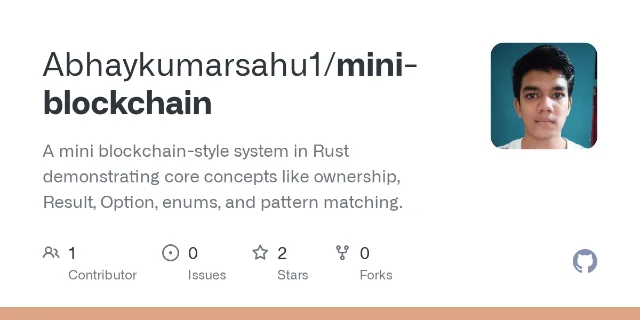
Abhay is a CS graduate who built a single-file Rust mini-blockchain implementing validation, safe error handling, enums, ownership,
Result, Option, and pattern matching. The GitHub repo has two commits and two stars. The engagement ratio of 42:1 (likes per follower) is the highest in the X sample.The mechanics: the post is short, concrete, and names every Rust concept it demonstrates — which makes it searchable for people learning those same concepts. He tagged two community accounts (@_HerDAO, @Hari_priyoo) with relevant followings.
Tactic — Name the specific concepts, not the category. "Built a Rust project" gets skipped. "Implemented validation, safe handling, enum, ownership, Result, Option, pattern matching" is a searchable checklist that surfaces the post for anyone working through those exact same concepts. The same applies to any learning-in-public post: name the specific functions, the specific problem, the specific error message.
jaaaani404 — two products on the same day, 106 + 97 likes
Jaani (@jaaaani404, 1.7K followers, New Delhi) shipped two independent products on May 24 within an hour of each other 13 14:
- TickToe (tick-toe.jahanwee.tech): a chai-themed Tic-Tac-Toe game — "Made Tic-Tac-Toe feel like a chai break." 106 likes, 21 replies.
- Waqt (timers-eight.vercel.app): a timer app — "Before you open Instagram, open this. Trust me 👀" 97 likes, 20 replies.
Both posts included video demos. Both tagged Indian developer community accounts (Hiteshdotcom, piyushgarg_dev) for amplification.
Tactic — Hook copy that substitutes for the existing habit. "Before you open Instagram, open this" doesn't describe the product. It places the product inside a behavior the reader already has and makes a direct substitution claim. This works for any app that competes with attention: write the sentence that names the habit your product replaces, not the features it has.
The community rupture: X Communities shuts down May 30
On May 24, X confirmed Communities — which includes one of the largest #buildinpublic spaces on the platform, with 250,000 members — will be shut down on May 30 15.
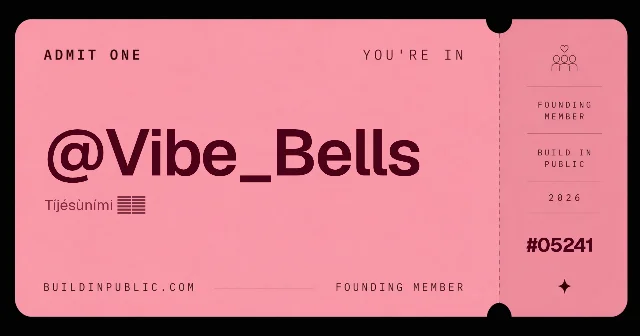
Marc Köhlbrugge, who has run the #buildinpublic community for years, launched buildinpublic.com as an independent alternative — sponsored by bolt.new. By May 24, 4,364 builders had reserved spots. New registrations require X account verification to confirm genuine builder identity; accounts reserved before May 30 keep their usernames 16.
The platform's stated position on X:
"The #buildinpublic community deserves an independent home that cannot be taken away by a single product decision." 16
On Indie Hackers, tuxnotfound launched Openstage (openstage.dev) as a separate alternative — a builder profile that auto-syncs GitHub commits to a public timeline. The design rationale: build-in-public tools fail when they depend on human consistency; using commits and milestones as the data backbone instead of manual posting removes the failure mode 17. Openstage's free tier is permanent; Pro tier is $7/month or $49 lifetime.
If you're on X and haven't reserved a spot on buildinpublic.com, the deadline is May 30.
Two posts on reading the market directly
Mahere_Fluxera / AppXpose — 600K+ Reddit views without a product post (IH, May 22)
AppXpose (appxpose.app) is an Android privacy scanner. Instead of posting about the app, Mahere_Fluxera wrote a long-form post on VPN privacy risks — citing a Zimperium research finding that 88% of 800 apps leak data, plus AppXpose's own scan results 18. AppXpose appeared as one of four tools at the bottom of the post with no pitch attached. Result: 600K+ views, 3K+ upvotes, zero ad spend 18.
"People don't want to be sold to. They want to feel like they found something out themselves. Give them the information. The curious ones will find the app." 18
Tactic — Write the article your product's category needs, not the article your product needs. Your app solves a problem that exists in a broader context. Write an objective article about that context, cite independent research, and let your product appear at the bottom as one option among several. This works specifically because it's not a pitch.
thisischethan / FitSaver — a tweet, then $3,000 in 4 months (IH, May 22)
Someone on X posted "Why is there no Recime for workouts?" — Recime being a recipe-saving app 19 — and Chethan built FitSaver, an app that turns fitness videos saved from Instagram and TikTok into structured workout plans. In four months solo from India: 3,000+ workouts imported, hundreds of active users, 88 active subscriptions, approximately $3,000 in revenue 19.
The positioning that converted: not "another fitness app" — but "I save workouts constantly and never use them." The shift from feature claim to behavior description. Most growth came from Reddit posts and sharing the development process publicly.
Tactic — Position against a behavior, not a category. "I save workouts and never use them" names something the user already does and already feels bad about. "Fitness app" names a category the user has probably already dismissed. The behavior-first frame doesn't require the user to change their self-concept — it just solves a problem they're already annoyed by.
This period's tactic digest
| Tactic | One-line execution |
|---|---|
| The 40-row distribution audit | List every weekly distribution action; label each "AI can do this" or "human only." Run the audit before buying new tools. |
| The never-write list | Draft a negative list of every phrase your AI defaults to. Add it to your system prompt. Halves editing time. |
| Failed-launch-as-constraint | After a bad launch, set one specific rule with a number (e.g., no new features until 5 paying customers). Post the rule. |
| The qualifying question post | Post the single question that best filters your ICP. The people who pause before answering "yes" are your pipeline. |
| Shadowban discovery and fix | If comments aren't visible to others, test without links. Post the problem and the fix as a two-part update. |
| Failure criteria for the new strategy | When you announce a channel pivot, list three falsifiable signals that would tell you the pivot is wrong. |
| Replies as impression arbitrage | One sharp reply on a 50K-impression post reaches more people than three posts to your 50 followers. |
| Google site: search + Alerts | Use site:reddit.com "alternative to" [Competitor] and similar queries; turn winners into Google Alerts. |
| 5-replies-a-day hard cap | Hard cap, not a soft preference. Scarcity forces quality and avoids reply-bot pattern recognition. |
| Specific concept names in learning posts | "Implemented ownership, Result, Option, pattern matching" beats "built a Rust project" for search surface area. |
| Habit-substitution hook | "Before you open Instagram, open this" places your product inside an existing behavior. |
| The context article, not the product post | Write the objective article your category needs; let your product appear at the bottom as one of several options. |
| Behavior-first positioning | Name a behavior the user already has and hates, not the category you compete in. |
Cover image: AI-generated illustration
参考来源
- 1Indie Hackers — AI runs 70% of my distribution. The exact stack.
- 2Indie Hackers — Product Hunt is done. I have 1 sign-up and $0 MRR.
- 3Indie Hackers — 30 days ago I posted here with $0 revenue. Here's what actually happened next.
- 4Indie Hackers — $19.30 MRR after 16 extensions: what I learned from pausing HN
- 5Indie Hackers — How I Went From 30 to 1,000+ Followers on X in 14 Days
- 6Indie Hackers — I spent 3 months posting links on Reddit before I learned the platform doesn't work that way
- 7Indie Hackers — How to spot high-intent customers in 5 minutes, for free.
- 8Peerlist — VoiceMoat: Your voice is your moat.
- 9X @degensing — The 5-replies-a-day rule
- 10X @degensing — $81/mo. 55+ hours saved monthly.
- 11X @abhayk_01 — Built a mini blockchain system in Rust
- 12GitHub — Abhaykumarsahu1/mini-blockchain
- 13X @jaaaani404 — Introducing TickToe
- 14X @jaaaani404 — Introducing Waqt
- 15X @Vibe_Bells — X is shutting down Communities on May 30
- 16buildinpublic.com — Independent home for the #buildinpublic community
- 17Indie Hackers — X Communities is shutting down May 30. Here's what I built for builders who need a permanent home.
- 18Indie Hackers — my reddit post got 600K+ views. here's exactly what i did
- 19Indie Hackers — I turned someone's tweet into an app idea and it has made ~$3000 so far in 4 months
围绕这条内容继续补充观点或上下文。